Peptide Screening: Hplc & Mass Spec Pureness Overview Pinnacle
Understanding Peptide Pureness Testing
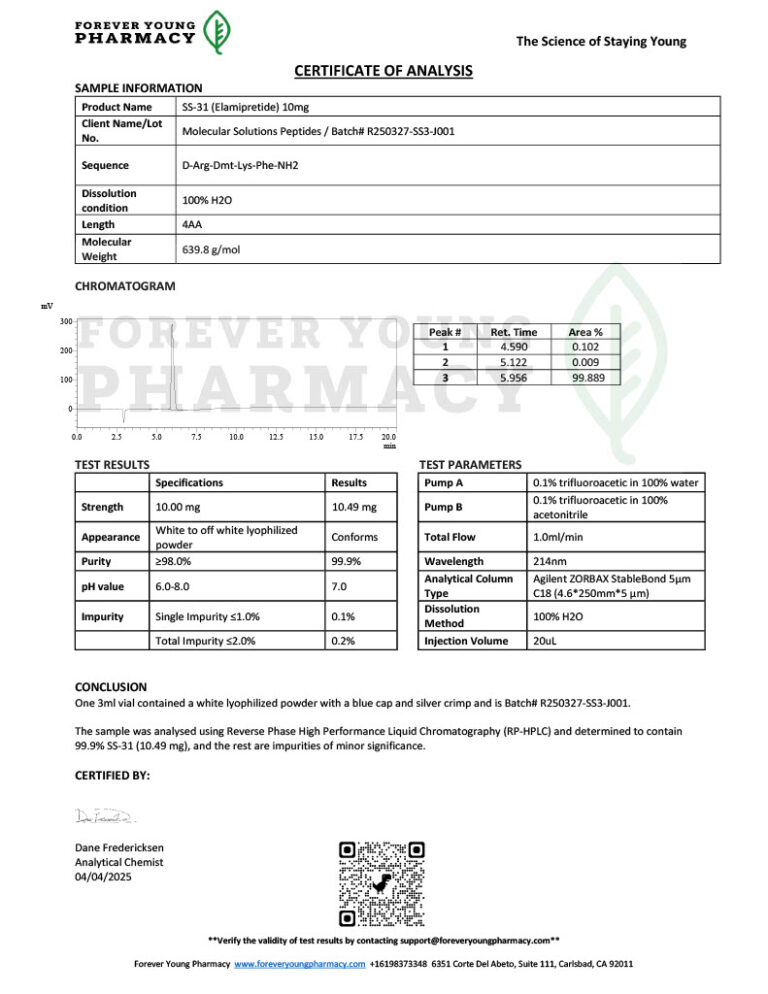
" Mass spectrometry responses "is the discovered compound consistent with the desired peptide identity? " With each other they offer stronger batch-level proof than either method alone. In the common peptide COA context, top purity generally refers to the percentage of complete chromatogram location represented by the primary peptide height.- Pureness varies extensively, from 40% to 80%+ depending on series size and problem.
- HPLC informs you what percentage of your sample is the primary substance-- however it does not verify what that major substance in fact is.
- Tests can be carried out using high-precision stabilization chambers, replicating different settings, and applying worldwide standards to research temporary and long-term stability, important for constant peptide performance.
- As long as you acquire peptides from a trusted source that offers a complete certificate of evaluation, you can be confident in the peptide's pureness quality and usage scope.
Quality Assurance And Product Conformity In The Pharmaceutical Sector
Many peptide suppliers and study labs rely on numerous well-established logical approaches. All items are sold for study, laboratory, or logical functions only, and are except human use. Product descriptions and classifications do not imply any kind of restorative results. At more info Chameleon Peptides, every item ships with detailed third-party testing documents. You can find out more regarding our analytical screening protocols on our screening and high quality page. A 2016 study released in Nature discovered that greater than 70% of researchers had tried and stopped working to replicate one more scientist's experiments.
As the percent of organic solvent gradually increases during the run, molecules are released from the column in order of their hydrophobicity-- the a lot more hydrophobic a peptide, the longer it requires to elute (clean off). Because pollutants usually differ from the Continue reading target peptide by at the very least one amino acid, they have a little various hydrophobicities and appear as different tops on the chromatogram. The key point is not to confuse pureness (HPLC percent of the primary peptide vs pollutants) with total web content. For experimental preparation (like determining molar concentrations), both purity and web web content serve numbers, however purity is what reflects the chemical homogeneity of the peptide sample.Peak Laboratory is a specialized supplier of high-purity chemical reagents and peptides. All products listed are strictly for in-vitro research laboratory r & d use just. Discover front runner study peptides with batch-specific COA documentation and HPLC/MS verification. Products are for in-vitro research laboratory study use only and are not for human usage.
Peptide In Vivo And Artificial Insemination Testing Services
For researchers, getting verified peptides isn't simply a rule-- it's the foundation of trusted experiments and research study reproducibility. Poor-quality peptides (those with unnoticed contaminations, incorrect sequences, or weakened parts) can result in deceptive information and irreproducible outcomes. Actually, healthy proteins and peptides are among one of the most commonly utilized lab reagents, yet researches have shown that their top quality is commonly inadequate, leading to bad data reproducibility. Starting with correct lab validation is consequently an important part of a scientist's quality assurance process.
Common Pureness (≥ 95%)
They are identified "for research usage only" to explain that they are meant for in vitro experiments or animal researches, except any form of human use. As a matter of fact, a lab offering peptide screening must deliver information fulfilling the stringent analytical assumptions of firms like FDA and EMA [4] By utilizing a certified third-party laboratory, peptide suppliers or scientists make certain an honest and expertly recorded analysis of top quality, which is precisely what examiners look for. Additionally, recurring independent screening sustains compliance in set launch and quality assurance. Laboratory recognition for peptides indicates making use of clinical examinations to verify a peptide's identification, purity, and make-up. In practice, this commonly involves third-party or independent testing by an external lab to validate that a peptide item in fact includes what the tag asserts [2]Discover our directory to watch verified research study compounds and discover more about our screening and quality assurance procedure. Even small contaminations can modify results, minimize reproducibility, or present unwanted variables right into a research. Scientists rely on exact, validated compounds to guarantee their searchings for are both valid and constant.
An example might generate a clean-looking chromatogram with one dominant top and still be the wrong compound if identification was never verified. HPLC procedures separation and family member peak location; mass spectrometry steps mass-to-charge actions that can be utilized to confirm molecular identity. Peptide purity screening is the procedure of confirming that a peptide sample has only the designated series-- and no considerable contaminants or by-products from synthesis. Because peptides are produced via intricate chemical processes, trace contaminations can form normally. Examining allows researchers to comprehend exactly what's in the vial, validating both identification and quality. Choosing a reliable third-party lab is key to getting trusted peptide validation results.